
Dubai Real Estate: When to Sell? Lessons from the COVID-19 Pandemic for Market Volatility Preparedness
In early March 2026, tensions from the Iran crisis are enveloping Dubai. Many investors are likely feeling anxious, having heard news of a 20-30% plunge in the Dubai Financial Market (DFM) real estate equity index within a few days. However, the history of Dubai real estate is also one of "strengthening with every crisis."\n\nThis time, we will look back at market trends during the COVID-19 pandemic in 2020, which was the biggest shock to date, and consider strategies in the wake of the current Iran crisis.\n\n---\n\n### Lessons from the COVID-19 Era: Why Did "High Transaction Volume, Low Prices" Occur?\n\nLooking back at the Dubai real estate market in 2020, a strange discrepancy was observed: transaction volumes were maintained (approximately 55,000 units), while the price index plummeted to a 10-year low (914-916 AED/sqft). This phenomenon was driven by four structural factors that are also relevant to the current crisis.\n\n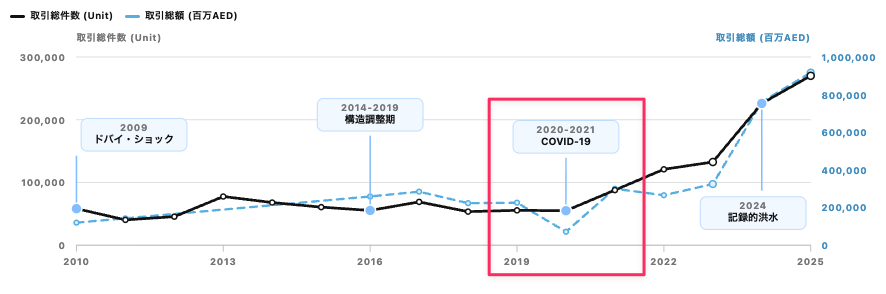 \n\n1. Supply Glut and the Peak of a "Buyer's Market"\n \n 2020 marked the final stage of a market correction that began in 2014. The shock came immediately after a record number of new properties were completed in 2019, maximizing downward pressure on prices and creating the "ultimate buyer's market" where buyers could secure overwhelmingly favorable terms.\n \n2. Shift from Off-Plan to "Ready Properties"\n \n Due to the uncertainty of the crisis, demand for unfinished "off-plan properties" sharply decreased by 32%, while transactions for more affordable "ready properties" (secondary market and completed units) increased. As ready properties, which trade at market bottom prices, became the focus of transactions rather than high-priced off-plan units with developer profits, the overall transaction value was pushed down.\n \n3. Divergence in Demand by Property Type\n \n With the widespread adoption of remote work during the pandemic, demand for spacious "villas" exploded, while prices for "apartments," which constitute the majority of the market, plummeted by nearly 15% in some areas. This extreme polarization made the overall statistical values appear lower.\n \n4. Decline in Mortgage Transactions (Rise of Cash Purchases)\n \n Global economic uncertainty led to a stronger tendency to avoid large borrowings, making end-users purchasing lower-priced properties with cash the dominant force. The exclusion of mortgage values from total transaction amounts also contributed to the perception of lower market values.\n\n### The 2026 Iran Crisis: How Will the Current Market Move?\n\nThe discrepancy in 2020, where "transaction volumes recovered but prices hit rock bottom," ultimately fueled the explosive V-shaped recovery from 2021 onwards. The current Iran crisis is also expected to follow a similar short-term scenario.\n\n- Financial Index Precedes Real Assets with a Time Lag The current 30% drop in the DFM index is due to psychological panic, but it typically takes 45 to 90 days for this to be reflected in actual real estate transaction prices. It is essential to remain calm, verify actual transaction data, and not be misled by news headlines.\n \n- "Safe Haven" DNA\n \n Historically, political instability in neighboring regions has triggered wealthy individuals in the area to transfer capital to Dubai for safety. This time too, inquiries from investors near conflict zones continue, suggesting extremely high mid- to long-term resilience.\n \n### Strategies for Existing Property Owners and Those Awaiting Completion\n\n- Ready Property Owners:\n \n Avoid panic selling and observe the market for three months. Concerned about a decline in tourists, consider switching from short-term rentals like Airbnb to "long-term rentals," supported by steady population growth, to secure cash flow.\n \n- Off-Plan Buyers: You should be prepared for several months of completion delays due to logistics disruptions. Do not rush to flip; instead, consider renting out the property after completion to secure yields, and adopt a mindset of waiting for market stabilization from 2027 onwards.\n \n- Prospective Buyers:\n \n Similar to 2020, maximize resilience to crises by focusing on areas with proven residential demand (e.g., Downtown, Palm Jumeirah) rather than oversupplied emerging areas, and properties from government-backed major developers like Emaar.\n \n### Conclusion\n\nDubai real estate has repeatedly gone through a cycle of "resetting with every crisis and evolving into a stronger end-user market." Just as the 2020 pandemic proved, the temporary stagnation caused by the current crisis holds the potential to be a "strategic buying opportunity" for future growth. Not succumbing to panic and monitoring assets with a long-term perspective of 5 to 10 years is the only path to success in Dubai investment.